
Local History · From Medina Township
Weymouth, the village the railroad passed by
Weymouth was Medina Township's first commercial heart. Mills, a cheese factory, a general store, and Ohio's oldest surviving Congregational church building. Then the railroad went to Medina City instead.
In 1817, three years after the county was organized, a man named Lathrop Seymour built the first sawmill and gristmill in Medina Township. He built them on a stream at what became a crossroads village called Weymouth. Judge Bronson named it. He was from Weymouth, Massachusetts.1
Within a generation, Weymouth had cheese factories, a general store, a hotel, blacksmiths, and a post office that ran from 1830 to 1905. Sedgwick and Clark's cheese factory produced 10 to 11 cheeses a day. Farmers wagoned dairy from all around into Weymouth to be shipped from there to Cleveland.2
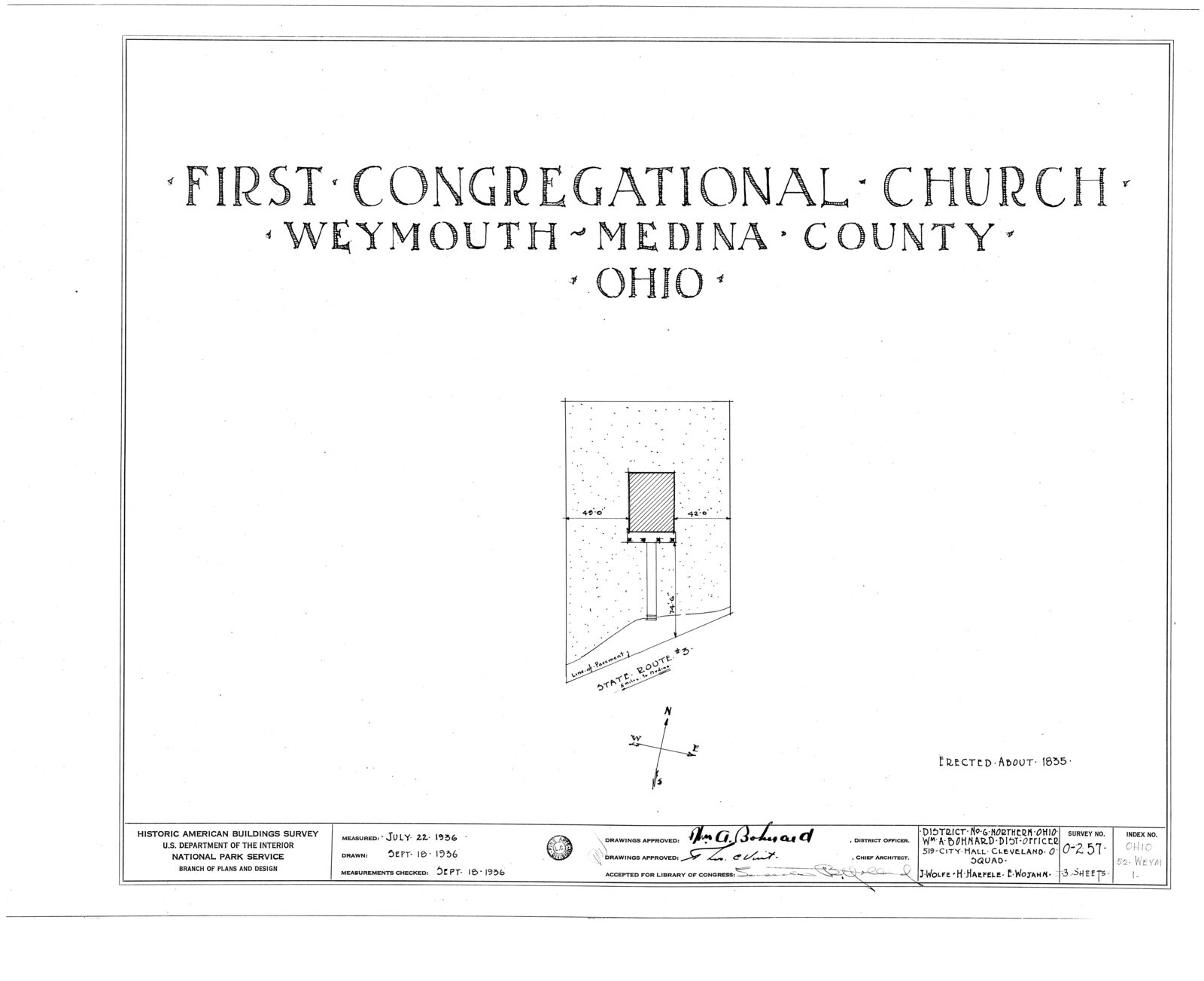
On January 19, 1835, Rev. Steven Barnes and sixteen men and women organized the Weymouth Congregational Church at the home of Lathrop Seymour. The meetinghouse went up over 1835 and 1836. It is Greek Revival, with a Doric-columned porch added in 1854. It is still standing. It is the oldest extant church building in Medina County.3
Then the railroad passed Weymouth by. It went to Medina City instead. Slowly Weymouth hollowed out. The cheese factories closed. The general store's business shrank. The post office finally shuttered in 1905, after 75 years of operation.
What is unusual about Weymouth is that it did not disappear. Most bypassed 19th-century hamlets in Ohio have very little left standing. Weymouth has the meetinghouse, the 1850 general store building at 3376 Old Weymouth Road, the Gothic Revival William H. Seymour House (on the National Register since 1979), the historic Weymouth Cemetery with 277 graves — and the volunteer Weymouth Preservation Society that has kept them all in shape.4
In the cemetery are Lemuel Graham, a Vermont militia veteran of the Revolutionary War who died 1844 at age 82; Jacob Welton, a War of 1812 veteran; Eliza Northrop Barnes, the township's first schoolteacher (1817); and Rev. Roger Searle, who founded St. Paul's Episcopal Church in Medina.5
The railroad decided Medina City. It could have gone through Weymouth. It didn't.
Footnotes
- 1817 first mills; Weymouth named by Judge Bronson. Documented on the Medina Township official history page and on the Weymouth Preservation Society site.
- Post office 1830-1905; Sedgwick and Clark cheese factory. Wikipedia gives 1824-1905 for the post office; Medina Township's site and the Preservation Society both use 1830. We use 1830 because both township-level sources agree.
- January 19, 1835 congregation organized; 1835-36 meetinghouse construction; 1854 Doric porch; oldest extant church building in Medina County. Documented by the William G. Pomeroy Foundation historical marker text and Wikipedia. The building was measured and photographed for the Historic American Buildings Survey (HABS OHIO,52-WEYM,1) in 1936.
- Surviving Weymouth structures. The 1850 general store (3376 Old Weymouth Road), the William H. Seymour House (3306 S. Weymouth Road; NRHP June 4, 1979), the meetinghouse, and the cemetery. Documented on the Medina Township site and by the National Register.
- Weymouth Cemetery notable burials. Names and dates from the Medina Township cemetery records.
Sources
- Medina Township, official history. medinatownship.com
- Weymouth Preservation Society. weymouthpreservationsociety.com
- William G. Pomeroy Foundation, First Congregational Church of Weymouth historical marker. wgpfoundation.org
- Historical Marker Database, Weymouth marker page. hmdb.org
- Wikipedia, “Weymouth, Ohio.” en.wikipedia.org
- Medina Township, Weymouth Cemetery. medinatownship.com
- Historic American Buildings Survey, HABS OHIO,52-WEYM,1, Library of Congress.
The Weymouth meetinghouse, the 1850 general store, the Seymour House, and the cemetery are all still there and can be visited. The Weymouth Preservation Society welcomes tasteful use of its holdings with credit.