
Local History · From Medina City
He lived with us until he died
A Union officer from Medina brought Thomas King home from Maryland in 1865. King lived with Congressman H.G. Blake's household until his death in 1875. His photograph, with a handwritten note on the back, was in the attic the whole time.
Harrison Gray Otis Blake, known as H.G. Blake, was born in Newfane, Vermont, in 1818, moved to Medina as a young lawyer, and on his first day in the Ohio House of Representatives in 1846 introduced a bill to repeal Ohio's Black Laws. A partial repeal passed in 1849. He later served in the U.S. Congress. His Greek Revival house on the corner of East Washington and Jefferson Streets in Medina was, from the 1840s until Emancipation, an Underground Railroad station.1
His daughter Elizabeth, interviewed by the Cleveland Plain Dealer in 1932, remembered being kept home from school when fugitives were hidden in the barn or the house. Her sister Helen once noticed "unusual quantities of bread and meat disappearing" from the kitchen. In 1858 Blake wrote a letter to two professors at Oberlin College, James Monroe and Henry E. Peck, that served, in effect, as an Underground Railroad travel document. That letter is still held at Oberlin.2
During the Civil War, Blake's son-in-law Robert McDowell served as a Union officer. In 1865, while stationed in Maryland, McDowell met a formerly enslaved man named Thomas King and, at the war's end, invited him to come home to Medina.3
King came. He lived in the Blake household, the same house that had sheltered fugitives ten years earlier, until his death in 1875. One year later, Blake himself died. The people who had built the station were gone within a generation. Thomas King had no obvious way to be remembered outside the family.
He was remembered anyway. Someone in the household kept his photograph. On the back, in ink, someone wrote: "He lived with us until he died."4
Between 2019 and 2021, the Medina County Historical Society restored the McDowell family's later home, the McDowell-Phillips House at the corner of North Prospect and Blake Streets, and opened it as a public museum. During the restoration, the photograph of Thomas King was found in the attic.5
In 2022, Spring Grove Cemetery on West Union Street was accepted into the National Park Service's National Underground Railroad Network to Freedom, in part on the strength of the Blake papers. H.G. Blake is buried there. So is Elizabeth Bell Blake, his wife. So is Lieutenant Colonel Herman Canfield, another Medina abolitionist and Ohio senator killed on the first day of Shiloh in 1862.6
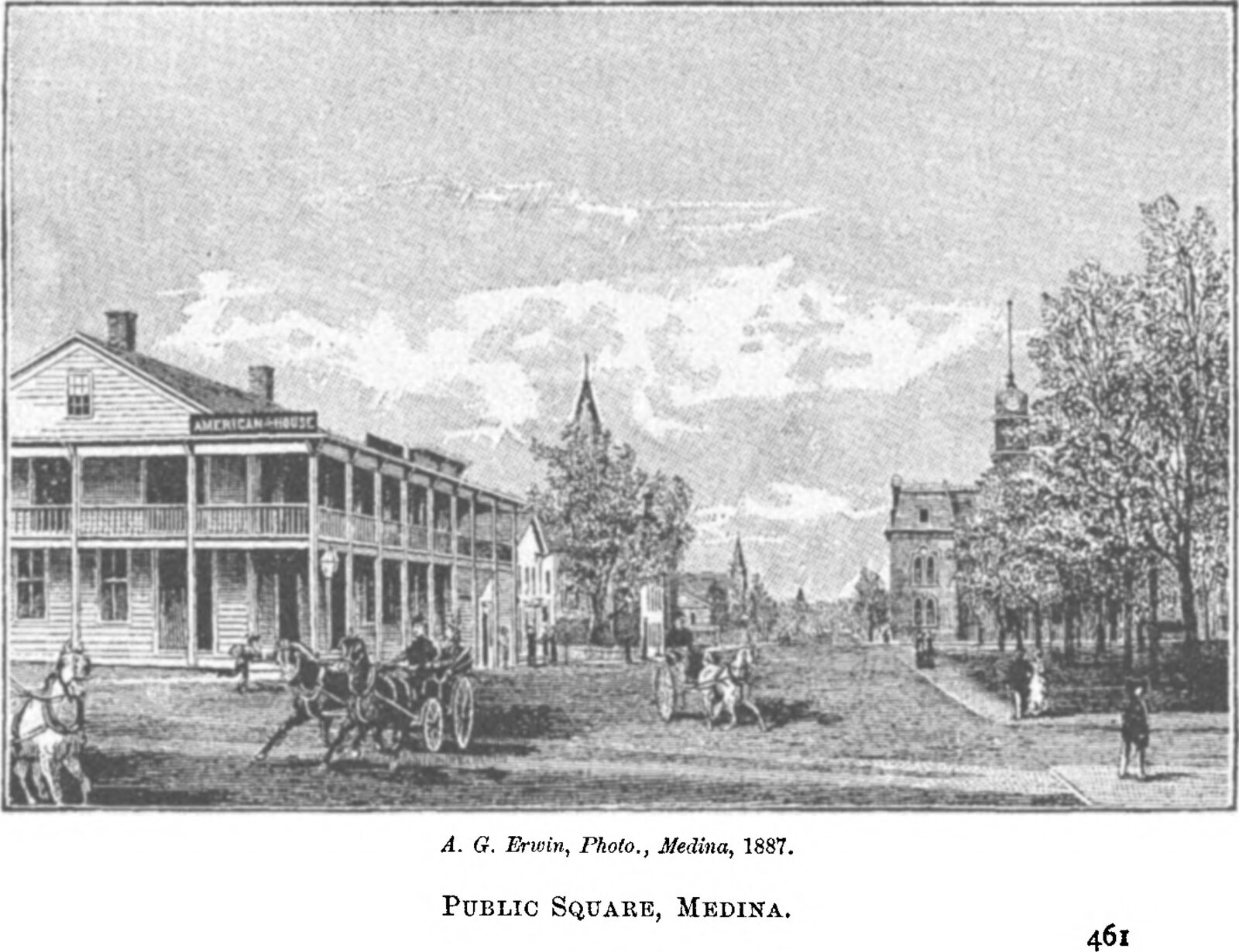
The Blake house on East Washington and Jefferson is gone. The Old Phoenix Bank building Blake helped run stands rebuilt on the Square after the 1870 fire. The McDowell-Phillips House opens the second Sunday of every month. The photograph of Thomas King is inside.
Footnotes
- Blake biography and 1846 Black Laws bill. Blake's birth (March 17, 1818, Newfane, Vermont), his 1846 introduction of the repeal bill on his first day in the Ohio House, and the 1849 partial repeal are documented across Wikipedia's Harrison G. O. Blake entry, the MCDL Genealogy Blog's April 2017 profile, and Your Ohio News's biographical piece by Gloria Brown.
- The 1932 Cleveland Plain Dealer interview with Elizabeth Blake McDowell. Cited by Gloria Brown for Your Ohio News, drawing on family descendant Betsy Whitmore. The 1858 letter to Oberlin professors James Monroe and Henry E. Peck is documented in the Spectrum News 1 coverage of Spring Grove Cemetery's Underground Railroad Network to Freedom designation.
- McDowell meets Thomas King in Maryland, 1865. Reported by Ideastream Public Media in the June 2026 story on the McDowell-Phillips House Museum. Sources describe King only as having “escaped from enslavement in the South as a young man” before meeting McDowell in Maryland; earlier details of his life are not documented and are not filled in here.
- The photograph and its handwritten note. Discovered during the McDowell-Phillips House restoration and reported by Ideastream in June 2026. The photograph and the ink note on its back are held today by the Medina County Historical Society.
- McDowell-Phillips House restoration (2019–2021). The Historical Society's project earned an Ohio History Connection State Historic Preservation Office award. The house opens second Sundays, 1 to 4 p.m., per the Society's own listing.
- Spring Grove Cemetery on the National Park Service Network to Freedom. Designation confirmed 2022 per Spectrum News 1 reporting. Both H.G. Blake and Herman Canfield are buried there.
Sources
- Anna Huntsman, “'He lived with us until he died.' Medina museum highlights local Underground Railroad ties,” Ideastream Public Media, June 16, 2026. ideastream.org
- Gloria Brown, “H.G. Blake: Medina congressman and Underground Railroad figure — 'An ardent anti-slavery man,'” Your Ohio News. yourohionews.com
- “Medina's Spring Grove Cemetery on Underground Railroad Network to Freedom,” Spectrum News 1 Ohio, June 17, 2022. spectrumnews1.com
- MCDL Genealogy Spot, “H.G. Blake,” April 2017. mcdlgenealogyspot.blogspot.com
- Wikipedia, “Harrison G. O. Blake” (biographical dates and Congressional record). en.wikipedia.org
- Medina County Historical Society, McDowell-Phillips House. medinacountyhistoricalsociety.com
- Ohio History Connection, McDowell-Phillips House SHPO Award. ohiohistory.org
- Elizabeth Blake McDowell interview, Cleveland Plain Dealer, 1932 (referenced via Your Ohio News reporting).
The photograph, the handwritten note, the McDowell-Phillips House, the Blake grave in Spring Grove, and the Old Phoenix Bank building on the Square are all in Medina today. The photograph can be seen at the house during public hours on the second Sunday of each month.