
Local History · From Liverpool Township / Valley City
The five silver dollars, the fifty kettles, and the salt spring that named Liverpool
The 1810 handshake with a Potawatomi guide, the fifty boiling kettles of brine, and the Erie Canal that ended it all in 1825.
Sometime early in 1810, a Revolutionary War veteran named Seba Bronson Jr. left Columbia Township and settled on the Rocky River in what is now Liverpool Township. He had heard the ground held salt. He had heard the Potawatomi knew where to find it.1
Bronson and his partner Jared Pritchard found a Potawatomi guide and paid him five silver dollars for the location of the hidden salt spring. That figure is passed down from the memoirs of Moses Deming, a settler's son who arrived the next year and began writing them down in 1849. It is oral tradition put to paper decades later. It is also the version the Liverpool Township Historical Society bolted to a bronze marker in 2010.2
Bronson did not keep the spring. A Connecticut newcomer named Justus Warner outmaneuvered him through Judge Walworth of Cleveland and General Perkins of Warren. By 1811 Warner was boiling brine over twelve iron kettles. Within a few years he had fifty. The salt sold for five dollars a barrel, then fifteen, then twenty. It was the first industry in Medina County.3
In December 1813, an Ohio settler named Ephraim Lindley walked twenty-five miles from Hudson to Liverpool to buy half a bushel of salt. He walked home through wolves. The trip is recorded in N. B. Northrop's 1861 Pioneer History of Medina County, which is independent of the Deming memoirs and confirms the salt works was operating.4
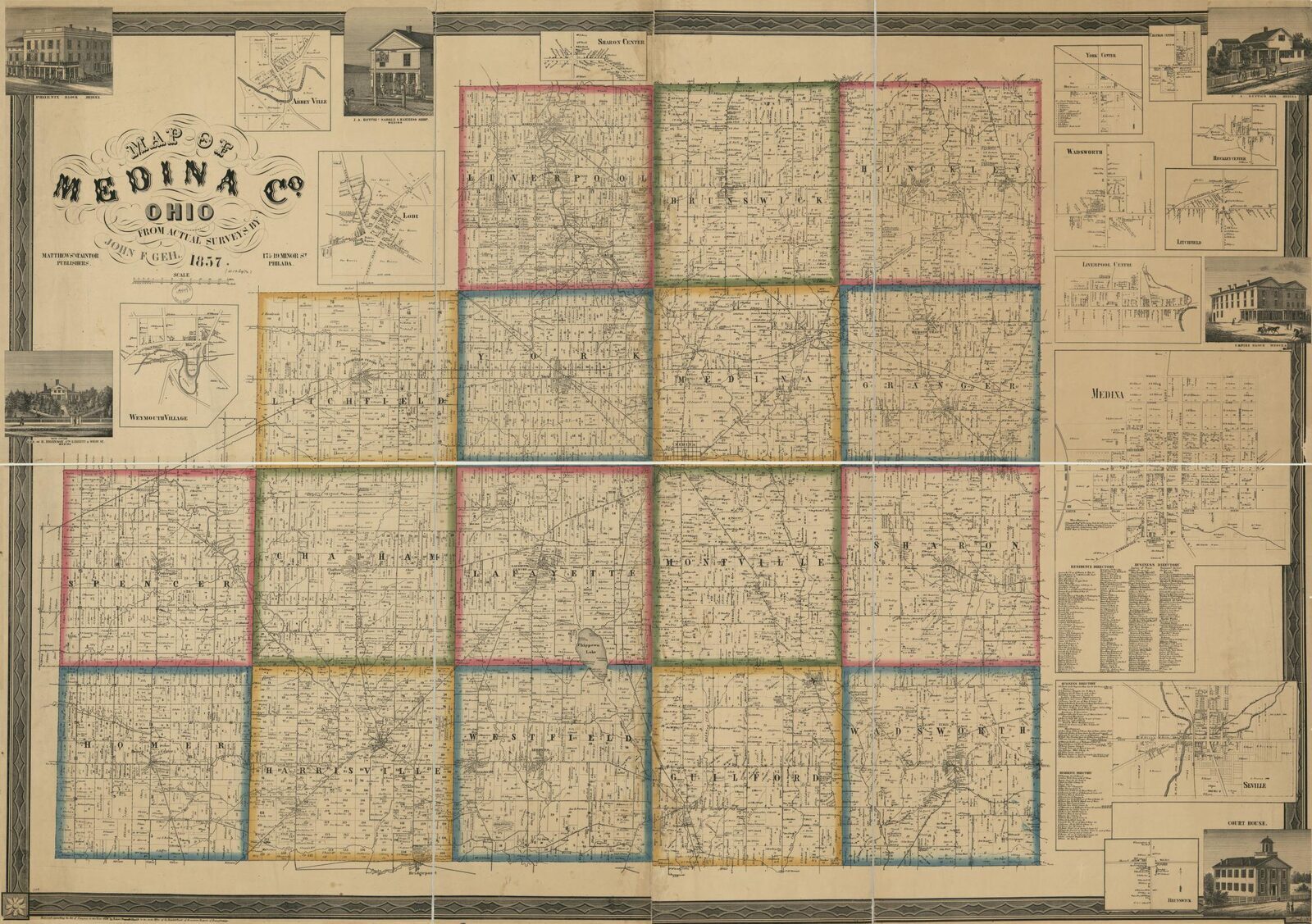
The settlement around the works picked up the name "Hardscrabble." People knew what they meant by it. In 1816 Daniel Coit, the Connecticut Land Company proprietor, formally named the township Liverpool, after the English salt-works city on the River Mersey.
The Erie Canal opened in 1825. Cheaper salt from New York state reached Ohio by water. The Liverpool works closed. Within twenty years the industry was completely gone. The name "Hardscrabble" outlasted the salt by nearly two centuries: the old tavern at the corner of Columbia and Grafton Roads carried the name until about 2000, when it was rebranded as the Jumping Frog Tavern.5
Ruth Deming, wife of the salt master's brother, became the first white settler death in Medina County on July 26, 1812. She is buried in Myrtle Hill Cemetery, which grew up around her grave. The 2010 bronze plaque stands next to the Liverpool Township Depot Museum at 6615 Center Road. The salt spring is on private land.
Footnotes
- Seba Bronson Jr., 1810 arrival, identified as a Revolutionary War veteran. The Revolutionary War identification is universal in local sources (Northrop 1861, Perrin 1881, the Valley City Historical Society timeline, and the 2010 bronze plaque), but a federal pension record has not been independently verified in this research. Treat as "identified as a Revolutionary War veteran by local histories."
- Five silver dollars for the salt spring location. The figure traces to Moses Deming's memoirs, begun 1849, then repeated in Northrop 1861, Perrin 1881, and the 2010 bronze marker. Not a period receipt; a settler's son writing four decades after the event.
- Warner's takeover, twelve to fifty kettles, prices from $5 to $20 a barrel. The Valley City Historical Society timeline gives the specific kettle counts and price range, sourced back to Perrin's 1881 chapter on Liverpool Township.
- Ephraim Lindley's December 1813 salt trip from Hudson. Recorded in Northrop's 1861 Pioneer History of Medina County. This is the earliest independent confirmation that the works was in operation, from a source with no relation to the Deming family.
- 1825 Erie Canal closure, Hardscrabble name, Jumping Frog Tavern. The Erie Canal effect is documented on the 2010 bronze plaque and in the Valley City Historical Society timeline. The Post Office renaming to "Valley City" in 1910 (to end confusion with East Liverpool, Ohio) is on the plaque and confirmed by the Wikipedia entry. The tavern's rebranding date of about 2000 is per Liverpool Township's own historical materials.
Sources
- “Liverpool's Salt Spring Story” (bronze marker text, dedicated 2010, next to the Depot Museum), Liverpool Township Historical Society. valleycity.org (PDF)
- Valley City Historical Society, “Early History of Liverpool Township/Valley City, Ohio,” v2 (May 2024). valleycity.org (PDF)
- Liverpool Township official history page. liverpooltwp.org
- N. B. Northrop, Pioneer History of Medina County (Medina: Geo. Redway, 1861). Public domain. archive.org
- W. H. Perrin, J. H. Battle, & W. A. Goodspeed, History of Medina County and Ohio (Chicago: Baskin & Battey, 1881), Chapter XV (Liverpool Township), p. 536. Public domain. archive.org
- Wikipedia, “Valley City, Ohio.” en.wikipedia.org
Two independent 19th-century histories (Northrop 1861 and Perrin 1881), the 2010 bronze plaque outside the Depot Museum, and the Valley City Historical Society's compiled timeline all agree on the main facts. Where a detail rests on a single 19th-century memoir, the story labels it as such.