Local History · From Creston Village
The village Jay Gould put on the map
Creston exists in its current form because it was the linchpin junction in Jay Gould's failed transcontinental railroad scheme. The three-railroad convergence he engineered kept the village humming for a century.
Creston was called Pike Station when it got its first post office in 1865. Isaac Wells platted the first map of the settlement in 1870. In 1881 the settlement got a new name — Creston — the same year a national financier named Jay Gould made it a rail junction.1
The Wheeling & Lake Erie Railroad had been founded in 1871 to run from the Ohio River, through southeastern Ohio's coal fields, to Lake Erie. It struggled for a decade. Locals called it the “Wailing and Leg Weary.” It shut down in 1879.2
Jay Gould started buying up Wheeling stock in 1880. By late that year he owned it. In early 1881 he began rebuilding the line — but with an angle. He wanted an interchange point where the W&LE could meet the New York, Pennsylvania & Ohio Railroad, so he could push traffic through to Youngstown. He picked Creston for the junction.3 The village's post office was renamed from Pike Station to Creston that same year.
Gould's grand plan collapsed in the Panic of 1883. The W&LE went into receivership on July 7, 1884. But the three-railroad convergence he engineered kept working. The Baltimore & Ohio also came through. So did an interurban trolley line from Cleveland to Wooster. For most of a century, Creston was a rail town.4
Warden Wheeler, a Civil War veteran, had moved to Pike Station in 1869. When Creston was formally incorporated as a village on June 2, 1899, he was elected its first mayor.5
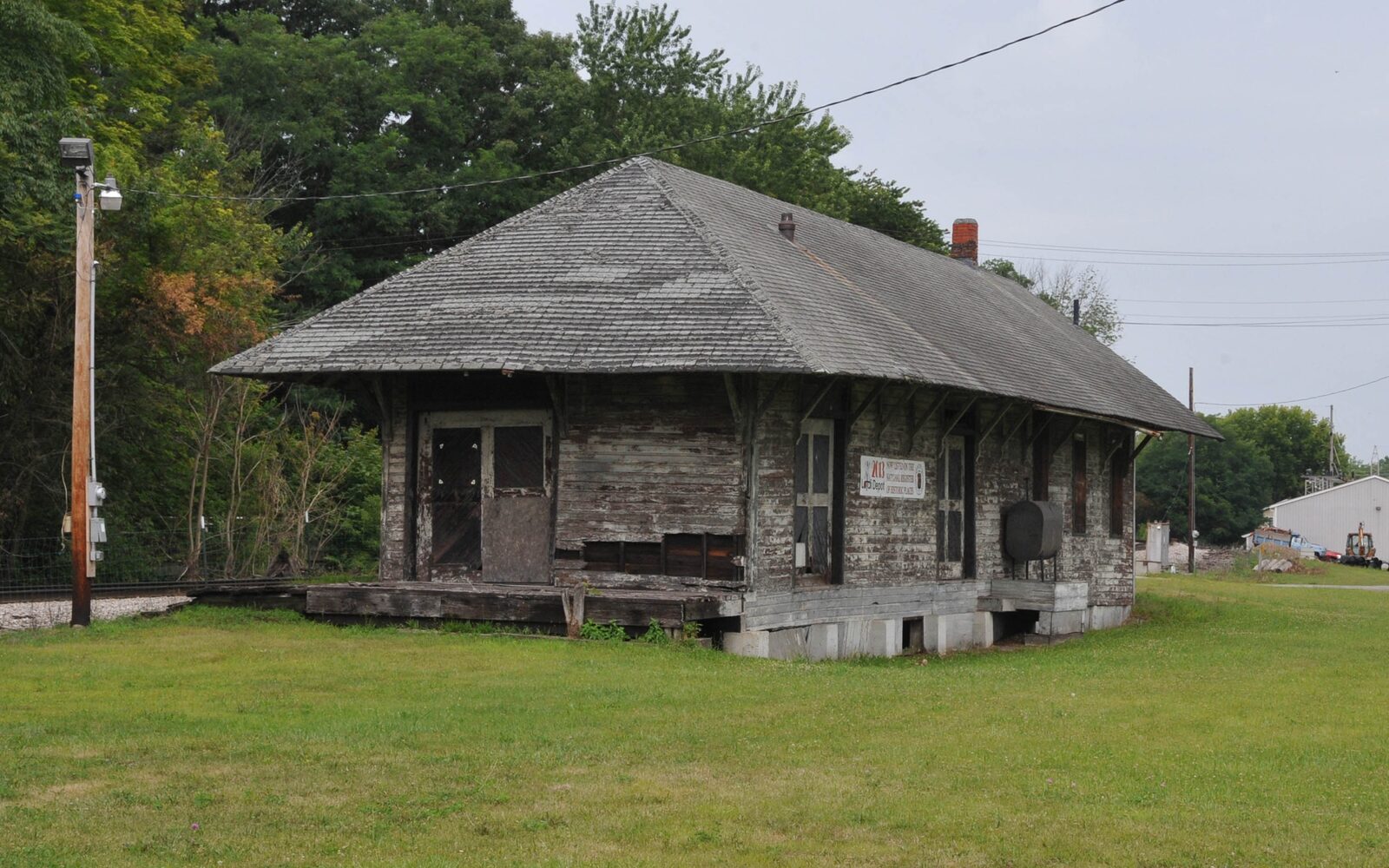
The Erie-Conrail line died in 1980. But the W&LE line (later Norfolk & Western) is still active. Its grade crossing with the former Erie line was photographed as recently as April 2024. Trains still roll through the village Jay Gould made a junction.
Footnotes
- Timeline of names. Village of Creston history and Wikipedia entry: Pike Station post office 1865; Isaac Wells plat 1870; Creston name and W&LE junction 1881; incorporated as a village June 2, 1899.
- W&LE early struggles and 1879 shutdown. Documented in Case Western Reserve's Encyclopedia of Cleveland History and Cleveland Memory Project.
- Gould's 1880 stock purchase and 1881 rebuild, Creston as junction with NYP&O. American-Rails.com and the Wikipedia entry on the Wheeling and Lake Erie Railway (1916-1988) both document this. Cleveland Memory Project confirms the 1880 stock buying.
- 1883 Panic; W&LE receivership July 7, 1884; three-railroad convergence sustained. American-Rails.com; Village of Creston's own history page.
- Warden Wheeler, first mayor June 2, 1899. Village of Creston history page. His exact Civil War regiment/rank is not verified in accessible online sources.
Sources
- Village of Creston. crestonvillage.org
- Wikipedia, “Creston, Ohio.” en.wikipedia.org
- Case Western Encyclopedia of Cleveland History, Wheeling & Lake Erie Railroad. case.edu
- Cleveland Memory Project, W&LE history. clevelandmemory.org
- American-Rails.com, Wheeling & Lake Erie. american-rails.com
- Wikipedia, “Wheeling and Lake Erie Railway (1916-1988).” en.wikipedia.org
The founding-date sequence for Creston has some spread across sources. We use the timeline (1865 post office, 1870 plat, 1881 name, 1899 village incorporation) that is consistent across the Village of Creston's own history and Wikipedia. The active W&LE crossing at Creston can still be photographed today.